
To determine how long your office can stay on during an outage, you need to accurately size your UPS by calculating your total power consumption. List all critical equipment, note their wattage, and consider starting surges. Then, select a UPS with enough capacity for your total load and desired backup time. Keep in mind that factors like battery health and device priorities affect runtime. For an easy guide on ensuring your setup’s efficiency, keep exploring the key steps ahead.
Key Takeaways
- Calculate total power needs by summing wattage of all critical office devices, considering power factor for accuracy.
- Choose a UPS with capacity exceeding total load to ensure reliable backup during outages.
- Assess battery capacity and runtime estimates based on connected device load, performing regular testing.
- Prioritize essential equipment to extend backup duration for critical systems during power interruptions.
- Plan for future growth by selecting scalable UPS solutions that can accommodate additional devices or increased load.
Why Calculating Your Office’s Power Needs Is Critical
Have you ever considered what could happen if your office loses power unexpectedly? Calculating your power needs is crucial to prevent disruptions. Modern battery technology has advanced, offering more reliable and longer-lasting backup options. Understanding your office’s total power consumption helps you choose the right UPS size, ensuring critical equipment stays operational during outages. It also enables you to optimize power efficiency, reducing energy waste and lowering costs. Without accurate calculations, you might under or overestimate your needs, risking data loss or unnecessary expenses. Knowing your power requirements allows you to select a UPS that provides sufficient backup time, safeguarding your business continuity. Additionally, considering power system efficiency can help you reduce operational costs over time. Being aware of load balancing techniques can further enhance your system’s overall reliability. Properly assessing power capacity is essential for ensuring your office’s resilience during unexpected outages. Incorporating advanced battery management can improve backup performance and lifespan. Recognizing the importance of system scalability can also ensure your backup solution can grow with your business needs. In short, this step is indispensable to ensure your office remains productive and protected when the unexpected happens.
How to Calculate Your Office’s Total Power Consumption
Start by listing all your office equipment and noting their power requirements. Then, add up these values to determine your total load. This process guarantees you accurately assess your office’s power needs for proper UPS sizing. Additionally, consider regional flavor preferences to ensure your equipment supports your office’s unique needs. Remember that understanding your power consumption patterns can help optimize your UPS selection for efficiency and reliability. Recognizing power use variations throughout different times of the day can further refine your capacity planning. Conducting a comprehensive power audit can reveal hidden loads and help you make more informed decisions, such as accounting for peak demand periods to avoid underestimating your needs.
Assess Equipment Power Needs
To accurately determine your office’s total power consumption, you need to assess the power requirements of all your equipment. Start by listing every device, from computers and printers to servers and lighting. Check each device’s label or user manual for wattage or amperage ratings. Focus on energy efficiency; choosing energy-efficient equipment reduces overall load and prolongs UPS runtime. Don’t forget to take into account surge protection, as power surges can damage sensitive electronics and cause inaccurate power readings. By understanding each device’s power needs, you’ll get an accurate picture of your total load. This step ensures your UPS can handle your equipment’s demands without overloading, providing reliable backup during outages. Precise assessment helps you select the right UPS size for your office.
Calculate Total Load
Once you’ve identified the power requirements for each device, calculating your office’s total load becomes straightforward. To do this, multiply each device’s wattage by its power factor to account for energy efficiency and real power usage. Sum these adjusted wattages to find the total load in watts. Keep in mind that devices with a low power factor can increase your overall load, so selecting energy-efficient equipment helps reduce this impact. Regularly monitoring your power consumption can help identify energy inefficiencies and optimize your system. Being aware of ventilation requirements in your office ensures safe and efficient operation of your electrical systems. Proper ventilation not only maintains safety but also enhances overall system performance by preventing overheating. Be sure to include all critical devices, such as computers, servers, and lighting, in your calculations. This extensive approach ensures your UPS can handle your office’s actual power demands during outages. Additionally, understanding the importance of projector technology can help you optimize energy consumption and performance. Recognizing the energy efficiency of your equipment can further improve your overall power management. Accurate total load calculation is essential for choosing the right UPS size and ensuring continuous operation without overloading your system.
How to Choose the Right UPS Capacity for Your Office

To choose the appropriate UPS capacity, begin by evaluating your office’s power requirements to guarantee it can support your essential equipment. Next, appraise the battery capacity to supply sufficient backup time during outages. Don’t forget to factor in future expansion so your UPS can grow with your business without requiring an immediate upgrade. Additionally, consider weatherproof tool storage to ensure your backup power system remains protected against environmental factors.
Assess Power Requirements
Understanding your office’s power needs is crucial when selecting the right UPS capacity. To do this effectively, you must evaluate the total power consumption of your essential equipment, ensuring the UPS can handle peak loads. Consider how generator maintenance impacts backup times and overall power quality, as fluctuations can affect performance.
Here are key points to assess:
- List all critical devices and their wattage requirements
- Account for startup surges, which may be higher than running wattage
- Factor in future growth to avoid underestimating capacity
Evaluate Battery Capacity
How do you determine the right battery capacity for your UPS? Start with a capacity evaluation by analyzing your critical devices’ power needs and runtime expectations. Consider the battery’s longevity, guaranteeing it can support your office’s essential equipment during outages. The goal is to select a battery that provides enough capacity to keep vital systems running without unnecessary overcapacity, which can be costly and inefficient. Measure the total wattage of connected devices and determine how long you need backup power. This helps you estimate the required battery capacity in terms of VA or Ah. Remember, a well-chosen capacity balances sufficient runtime with battery longevity, optimizing your UPS’s performance and lifespan. Proper capacity evaluation ensures your office remains protected during power interruptions. Understanding the importance of co-parenting can help you develop better strategies for managing shared responsibilities during transitional periods.]
Consider Future Expansion
Thinking ahead when selecting a UPS capacity can save you from costly upgrades down the line. Incorporate scalability planning and future proofing strategies to ensure your system can handle growth. By estimating your office’s future needs, you avoid under or over-sizing now. Consider potential additions like new equipment, staff, or expanded office space. This foresight helps you choose a UPS with enough capacity to accommodate growth without immediate replacement. Additionally, understanding Power System Types can help you design a more adaptable and resilient backup solution. Recognizing safety considerations when planning your power backup can further enhance both system reliability and workplace safety. Incorporating system flexibility into your planning ensures your UPS can adapt to evolving office requirements, avoiding unnecessary disruptions. Paying attention to scalability options can make a significant difference in managing your office’s long-term power needs.
What Factors Affect Your UPS Runtime?

Several factors directly influence your UPS’s runtime, determining how long it can keep your equipment powered during an outage. Key among these is battery health; over time, batteries degrade, reducing backup duration. Additionally, the total load connected affects runtime—more devices draw more power, shortening backup time. The efficiency of your UPS also plays a role, as better efficiency conserves energy. Environmental conditions like temperature can impact battery performance, further affecting backup duration. To understand these factors better, consider this table:
| Factor | Impact on Runtime |
|---|---|
| Battery health | Degrades over time, reduces backup duration |
| Load connected | Higher load shortens backup time |
| Environmental conditions | Can affect battery performance |
| UPS efficiency | Higher efficiency prolongs runtime |
Understanding the horsepower of electric dirt bikes can also help you appreciate the energy demands of high-performance electric vehicles, which in turn influences considerations for backup power solutions.
How to Estimate Your UPS Runtime During a Power Outage
Estimating your UPS runtime during a power outage helps you plan effectively and guarantees your critical devices stay operational when it matters most. To do this, start by reviewing your UPS’s battery capacity and load requirements. Keep in mind that proper battery maintenance ensures peak performance and longer runtime. Use manufacturer specifications or perform a self-test to measure how long your UPS can power your devices. Remember, surge protection features also help prevent damage during outages, extending equipment lifespan.
- Check your UPS’s battery health regularly
- Calculate total power consumption of connected devices
- Test the runtime periodically to confirm estimates
How to Prioritize Devices for Extended UPS Backup
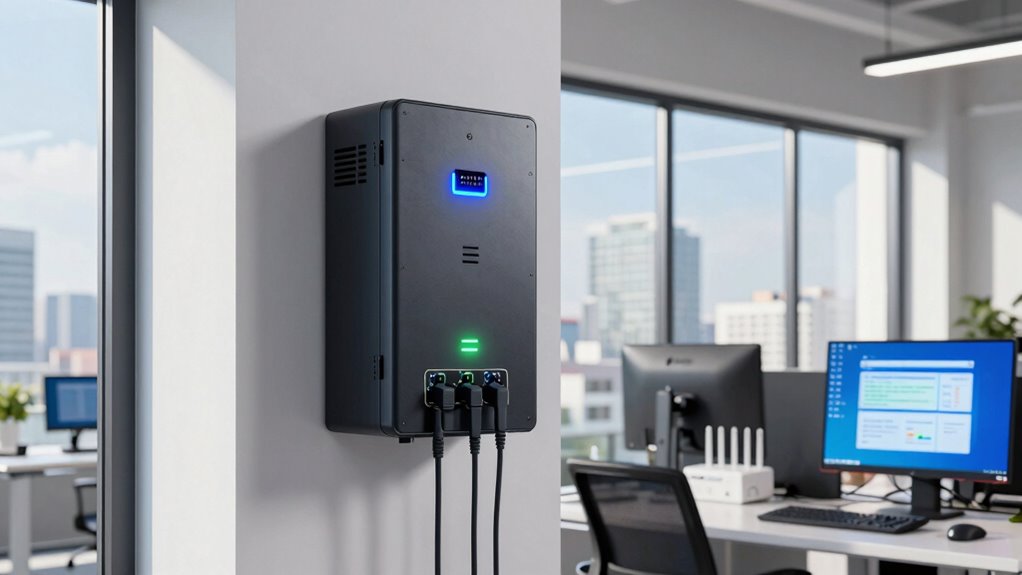
When managing an extended power outage, prioritizing your devices guarantees you maximize the available UPS backup. Effective device prioritization is essential for solid backup planning, ensuring critical systems stay online longer. Start by listing your devices based on importance: essential equipment like servers, networking gear, and medical devices should get top priority. Non-essential devices, like printers or secondary workstations, can be shut down first if the UPS runs low. Consider each device’s power consumption and role in your operations. By focusing backup resources on the most crucial equipment, you optimize runtime and reduce unnecessary drain. Remember, strategic device prioritization helps you make the most of your UPS capacity, giving your office time to recover or find alternative power sources.
Tips for Optimizing Your Office UPS Performance and Battery Life

To get the most out of your office UPS, optimizing its performance and extending battery life is essential. Proper battery maintenance ensures reliable backup power and prolongs battery lifespan. Additionally, improving energy efficiency reduces wear on the system and lowers operational costs. You can achieve this by regularly testing and calibrating your UPS, keeping vents clean for proper cooling, and avoiding overloads that strain the system. Also, consider scheduling periodic battery replacements based on manufacturer recommendations to prevent unexpected failures. Implementing these practices helps maintain peak performance and maximizes backup duration during outages. Remember, a well-maintained UPS not only safeguards your office equipment but also improves overall efficiency.
- Regularly test and calibrate your UPS
- Keep vents and cooling systems clean
- Avoid overloading the system
Common Mistakes to Avoid When Sizing a UPS for Your Office
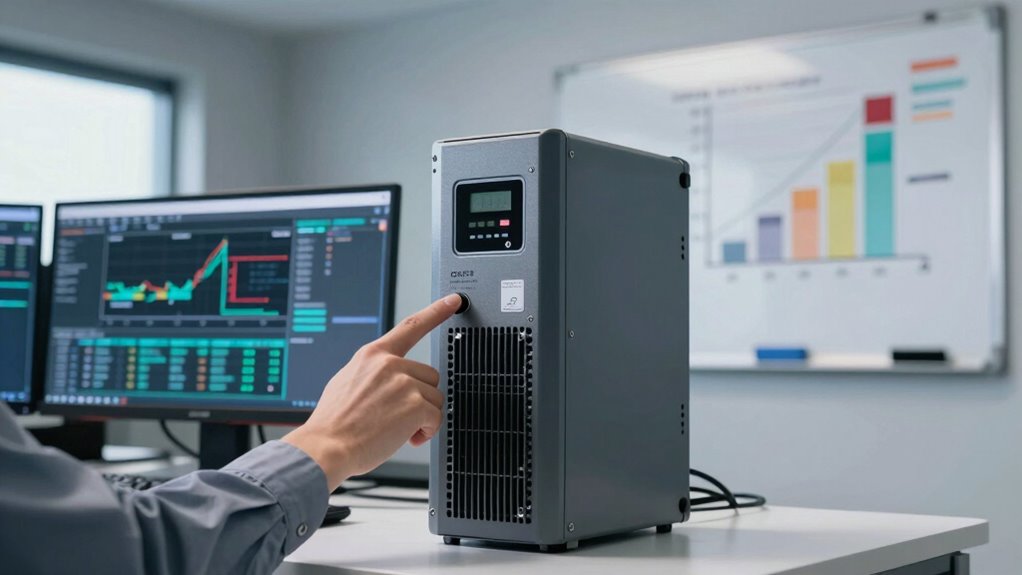
Choosing the right UPS size is essential for guaranteeing your office equipment stays protected without wasting resources. One common mistake is underestimating your power needs, which can lead to insufficient voltage regulation and system outages. Avoid overlooking battery maintenance; neglecting this can reduce backup time and damage your UPS. Conversely, overestimating capacity results in unnecessary expenses and energy consumption. Don’t forget to factor in future growth or additional devices. Improper sizing can also strain the system, causing overheating or reduced lifespan. Always perform accurate load calculations and consider how your UPS manages voltage regulation under varying conditions. By avoiding these mistakes, you guarantee reliable backup power, excellent performance, and a longer lifespan for your UPS.
Final Checklist for Proper UPS Sizing in Your Office

Before finalizing your UPS size, it’s essential to run through this checklist to make certain you’ve covered all crucial factors. First, verify that your batteries are well-maintained to guarantee reliable backup power when needed. Next, confirm that your UPS provides surge protection for your office equipment, safeguarding against power spikes. Finally, double-check the total power load of all devices you plan to connect to avoid overloading. Consider future expansion needs too, so your UPS can handle growth. Ensuring proper battery maintenance prolongs UPS life, and surge protection prevents damage during outages or surges. With these steps, you’ll confidently select a UPS that keeps your office running smoothly and securely during power disruptions.
- Battery maintenance and testing
- Surge protection capabilities
- Load calculation and future scalability
Frequently Asked Questions
Can I Upgrade My UPS Capacity Later if Needed?
Yes, you can upgrade your UPS capacity later if needed. Many UPS units offer scalability options, allowing you to enhance battery capacity or add additional modules. This means you can extend runtime or support more equipment without replacing the entire system. Just make certain your current UPS model supports these upgrades, and consult the manufacturer for compatibility and installation guidance. Upgrading is a smart way to future-proof your office’s backup power.
How Often Should I Test My Office UPS System?
You should test your office UPS system monthly to make certain reliable performance. During these tests, focus on battery maintenance by checking for corrosion, proper connections, and battery age. Also, verify surge protection features are functioning correctly to shield your equipment from power spikes. Regular testing helps catch issues early, prolongs your UPS’s lifespan, and guarantees your office remains protected and operational during outages.
Do Different Devices Impact UPS Runtime Differently?
Yes, different devices impact your UPS runtime differently because their device power varies, affecting how much battery is drained during an outage. High-power devices like servers or copiers use more energy, reducing battery lifespan and overall runtime. To maximize backup time, prioritize connecting essential devices and consider their power needs when sizing your UPS, ensuring it can handle the combined device load without compromising runtime or battery health.
What Safety Precautions Should I Take With UPS Installation?
When installing a UPS, you should wear safety gear like gloves and eye protection to prevent injuries. Always follow manufacturer instructions closely, especially regarding battery maintenance, to avoid leaks or explosions. Make certain the area is well-ventilated and keep a fire extinguisher nearby. Turn off power before connecting or disconnecting devices, and check for any damage or corrosion on the batteries regularly to maintain safety and efficiency.
Are There Environmental Considerations for UPS Placement?
Imagine your UPS as a silent guardian, quietly working behind the scenes. You should consider environmental impact and placement considerations by avoiding humid, dusty, or direct sunlight areas. These conditions can cause overheating or damage, reducing efficiency. Guarantee proper ventilation and stable temperatures. Thoughtful placement minimizes energy waste, protects components, and keeps your system reliable, all while respecting your environment. Your careful setup ensures a long-lasting, eco-friendly power backup.
Conclusion
Now that you know how to properly size your office’s UPS, you might worry it’s too complex or costly. But with careful calculation and prioritization, you’ll guarantee your critical devices stay powered during outages without overspending. Taking these steps means you won’t be caught off guard—your office stays productive and protected. So don’t hesitate; the right UPS setup is an investment in your business’s reliability and peace of mind.