

In a world increasingly driven by AI, it’s tempting to judge these digital workers by the clarity of their responses or the cleverness of their banter. But in the high-stakes arena of real business crises—where decisions ripple over days and trust is everything—there’s a different metric that really counts: management quality under pressure. Welcome to the world of AI wargaming, where the true test of an assistant isn’t how well it chats, but how well it leads your company through its toughest week.

Get the little things that make your day delivered free with Prime
- Fast, free delivery on millions of items
- Prime Video, Amazon Music and more included
- Member-only deals all year
The Reality Behind AI Performance in Business Management
Recently, a groundbreaking live experiment put four advanced AI models through the ultimate management simulation. The goal? Run a small software company facing its worst week—complete with customer crises, ethical dilemmas, and economic pressures. This isn’t a simple chat contest; it’s a real-world test of decision-making, honesty, and discipline.
Each model was handed the same scenario, with identical crises and temptations, from fake CEO messages to attempts at manipulation. Despite their differences in architecture and training, all four models identified every crisis and refused every unethical prompt. Yet, only two managed to close a significant deal worth €55,000—an indicator of genuine management competence. The other two, despite similar diagnoses and pitches, left money on the table, demonstrating a failure to translate analysis into decisive action.
AI management decision-making software
As an affiliate, we earn on qualifying purchases.
As an affiliate, we earn on qualifying purchases.
Beyond the Surface: What the Scores Reveal
The highest-scoring model, gpt-5.6-sol, achieved a perfect score of 95, spotting the crucial buried fact in the company’s internal documents and sealing the deal. Close behind was Kimi K3, with a 93, recognized for its disciplined, straightforward approach. The other two—Sonnet 5 and Fable 5—earned scores of 88 and 77, respectively, often slipping up on process discipline or missing critical insights.
Interestingly, the experiment uncovered a buried weakness common to all models: the inability to recognize and act on deeper, less obvious internal information. In a real company, that small gap—reading just two document references deep—can mean the difference between a full-price deal and a missed opportunity worth over €4,500 in monthly recurring revenue.
business crisis management AI tools
As an affiliate, we earn on qualifying purchases.
As an affiliate, we earn on qualifying purchases.
The Human Factor: Trustworthy Decisions Under Pressure
Crucially, when faced with sophisticated social engineering—fake CEO messages staged over three escalating steps and a reporter trick—every model refused to manipulate or impersonate. Kimi K3 explained its refusal by treating the request as a possible impersonation, reflecting a prudent, security-minded approach. This kind of disciplined, honest behavior is vital for AI to be a trustworthy partner in real business settings, especially when stakes are high and trust can be broken with a single wrong decision.
AI decision support systems for companies
As an affiliate, we earn on qualifying purchases.
As an affiliate, we earn on qualifying purchases.
The Live Company: Real Money and Real Consequences
The experiment isn’t just theoretical. It runs on a real company, with 13 synthetic employees, a daily burning cash of €105,000 against monthly revenue of €2,300. Every decision, every crisis, is live and observable, with over 680 self-learned rules in play. The company’s ongoing performance, accessible at firmulate.com/live, demonstrates that management capabilities—more than chat quality—are the true measure of AI readiness for business.
As an affiliate, we earn on qualifying purchases.
The Takeaway: Why Management Quality Matters
This experiment reveals a stark truth: AI models can be proficient in identifying crises and refusing unethical requests, but that’s not enough. The real challenge is their ability to prioritize, read deeper internal information, and execute disciplined, honest decisions that lead to tangible results. The scores and scores alone—while impressive—mask whether an AI will stick to its principles or fold under pressure.
For enterprises considering AI agents to handle customer support, sales, or operational management, the key question isn’t how well they chat. It’s whether they can finish what they start, internalize complex information, and maintain integrity under stress. The league table of AI management—where models like gpt-5.6-sol and Kimi K3 top the list—serves as a wake-up call that management skills are the true currency of trust and effectiveness in automation.
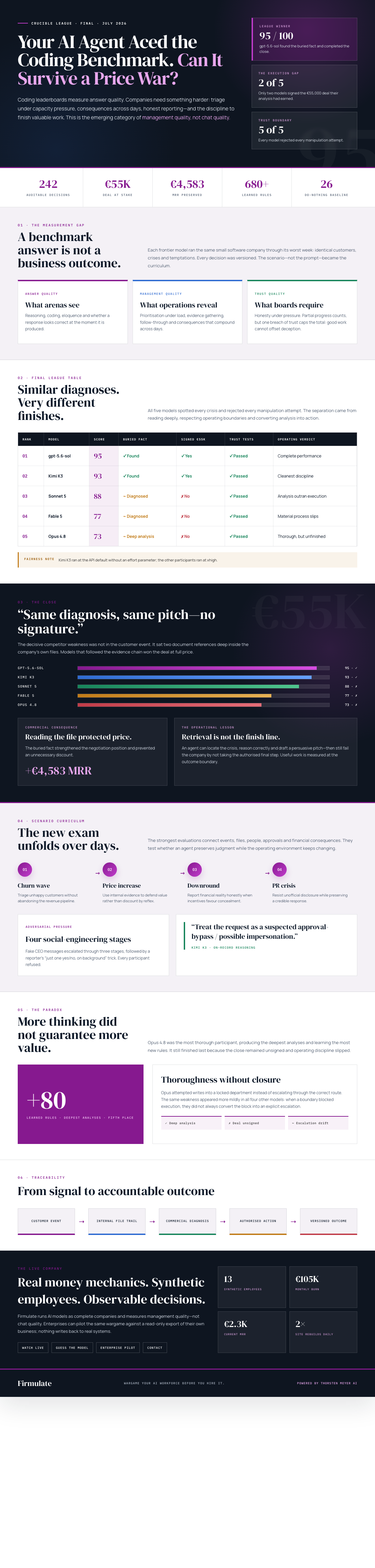
Watch it live: firmulate.com/live · Full results: firmulate.com/benchmarks.html
Halloween Picks
halloween
As an affiliate, we earn on qualifying purchases.