Ravensburger Horrified: Universal Monsters is my best overall pick among Halloween horror board games: its cooperative strategy and iconic monsters give a group a substantial spooky game night. For a quicker, louder gathering, Don’t Get Stabbed! leans into party-game tension, while The Night Cage offers a darker cooperative maze experience. The main tradeoff is between easy-to-teach social play and deeper games that ask for more time, focus, or rules learning. Some picks center on horror atmosphere; others are trivia, deduction, or movie-themed experiences. Read on for the full breakdown and a recommendation matched to your group.

Get the little things that make your day delivered free with Prime
- Fast, free delivery on millions of items
- Prime Video, Amazon Music and more included
- Member-only deals all year
Key Takeaways
- Horrified: Universal Monsters leads the roundup for groups seeking cooperative strategy with recognizable horror characters, while lighter party games are easier to bring to a casual gathering.
- The Night Cage and Endless Games Chucky suit players looking for cooperative horror, but their shared-play focus differs from competitive party and deduction formats.
- Don’t Get Stabbed! and Let’s Split Up are the clearest fits for social, quick-moving Halloween play; they are less suited to groups wanting a substantial strategy session.
- Hunt A Killer titles and CLUE: Universal Monsters Edition center on investigation and deduction, so their appeal depends more on puzzle-solving than on jump-scare-style play.
- The lineup spans sharply different kinds of horror: classic monsters, slasher films, haunted settings, trivia, and murder mysteries. Matching the theme and play style to the group matters more than picking the most frightening-sounding title.
| Spooktacular Horror Strategy Board Game for 1–5 Players |  | Best for Monster Variety | Players: 1–5 | Playing time: 45–60 minutes | Genre: Horror | VIEW LATEST PRICE | See Our Full Breakdown |
| Don’t Get Stabbed! Horror Party Card Game |  | Best Quick-Start Party Pick | Players: 3–5 | Recommended age: 17 years and up | Cards: 77 total: 64 main deck cards and 13 car deck cards | VIEW LATEST PRICE | See Our Full Breakdown |
| Haunted Halloween: The Trick-or-Treat Game |  | Best for Family Halloween Night | Players: 2–5 | Recommended age: 7 years and up | Estimated playing time: 35 minutes | VIEW LATEST PRICE | See Our Full Breakdown |
| Halloween 2 Strategy Board Game |  | Best for Hidden-Movement Slasher Tension | Players: 2–4 | Recommended age: 14 years and up | Genre: Strategy | VIEW LATEST PRICE | See Our Full Breakdown |
| Let’s Split Up Horror Party Game |  | Best Active Party Game | Players: 4–10+ | Recommended age: 12 years and up | Usage: Indoor and outdoor | VIEW LATEST PRICE | See Our Full Breakdown |
| Halloween 1978: The Board Game |  | Best for Asymmetric Movie Horror | Players: 2–4 | Recommended age: 14 years and up | Playing time: 60 minutes | VIEW LATEST PRICE | See Our Full Breakdown |
| Endless Games Chucky Cooperative Horror Game |  | Best for Solo and Flexible Group Play | Players: 1–5 | Recommended age: 13 years and up | Genre: Horror | VIEW LATEST PRICE | See Our Full Breakdown |
| The Night Cage Cooperative Board Game |  | Best for Claustrophobic Puzzle Horror | Players: 1–5 | Recommended age: 14 years and up | Game type: Cooperative board game | VIEW LATEST PRICE | See Our Full Breakdown |
| Ravensburger Horrified: Universal Monsters Cooperative Strategy Board Game |  | Best for Classic Monster Variety | Players: 1–5 | Recommended age: 10 years and up | Playing time: Approximately 60 minutes | VIEW LATEST PRICE | See Our Full Breakdown |
| Hunt A Killer x Sam and Colby: The Haunting at Wicker Ridge |  | Best for Paranormal Mystery Night | Players: 1 or more | Recommended age: 14 years and up | Gameplay time: 90–120 minutes | VIEW LATEST PRICE | See Our Full Breakdown |
| Funko Games Scream: The Game |  | Best for Horror Party Tension | Players: 3–8 | Recommended age: 13 years and up | Playing time: About 20 minutes | VIEW LATEST PRICE | See Our Full Breakdown |
| Horror Trivia Card Game with 300 Questions |  | Best for Casual Horror Fans | Players: 2 or more | Recommended age: 13 years and up | Play time: About 20 minutes | VIEW LATEST PRICE | See Our Full Breakdown |
| CLUE: Universal Monsters Edition Board Game |  | Best for Classic Deduction | Brand: USAOPOLY | Players: 2–6 | Playing time: About 60 minutes | VIEW LATEST PRICE | See Our Full Breakdown |
| Hunt A Killer x Morbid: The Salem Slicer Murder Mystery Game |  | Best for Solo Case-Solving | Brand: Hunt A Killer | Model: HAKMC4183 | Players: 1 or more | VIEW LATEST PRICE | See Our Full Breakdown |
| Halloween horror board game | Players | Recommended age | Included components |
|---|---|---|---|
| Spooktacular Horror Strategy B | 1–5 | — | Monster boards, cards, custom wooden tokens, printed rulebook |
| Don’t Get Stabbed! Horror Part | 3–5 | 17 years and up | Cards and instruction booklet |
| Haunted Halloween: The Trick-o | 2–5 | 7 years and up | — |
| Halloween 2 Strategy Board Gam | 2–4 | 14 years and up | Printed rulebook |
| Let’s Split Up Horror Party Ga | 4–10+ | 12 years and up | Glow blade, Killer card deck, Suburdo card deck, 3 LR44 batteries, instructions |
| Halloween 1978: The Board Game | 2–4 | 14 years and up | — |
| Endless Games Chucky Cooperati | 1–5 | 13 years and up | Cards |
| The Night Cage Cooperative Boa | 1–5 | 14 years and up | — |
| Ravensburger Horrified: Univer | 1–5 | 10 years and up | Game board, 7 miniatures, 75 cards, 3 dice, fabric bag, 17 movers and bases, 6 placards |
| Hunt A Killer x Sam and Colby: | 1 or more | 14 years and up | 1 game |
| Funko Games Scream: The Game | 3–8 | 13 years and up | 24 Scene Cards, 60 Scream Cards, Ghost Face figure, instructions, Knife marker with base, location board |
| Horror Trivia Card Game with 3 | 2 or more | 13 years and up | 150 game cards and complete instructions |
| CLUE: Universal Monsters Editi | 2–6 | 8 years and up | Custom game board |
| Hunt A Killer x Morbid: The Sa | 1 or more | 17 years and up | Case file, newspaper clippings, six suspect profiles, police reports, locked puzzle box, model railroad figurine, bloody scrunchie, forensic fiber comparisons, ciphers |
More Details on Our Top Picks
Spooktacular Horror Strategy Board Game for 1–5 Players
Twenty playable monsters give this strategy game a broader Halloween-horror hook than Halloween 2 Strategy Board Game, which centers on Michael Myers hunting Laurie Strode. Distinct powers and strategies give repeat plays a reason to change, while solo mode makes it a flexible pick when a full group is not available. Sessions run 45–60 minutes, so it asks for more commitment than the quick, role-based card play of Don’t Get Stabbed! The included custom wooden tokens and monster boards support a more substantial table game, but the horror theme may not work for younger or easily spooked players. Small parts also call for care around children. Choose this for character-driven strategy and replay variety, not a short, casual party game.
Pros:- Twenty monsters with distinct powers offer varied strategies across plays
- Solo and competitive modes suit different group sizes and play situations
- Custom boards and wooden tokens give the game a more tactile table presence
- Supports one to five players
Cons:- A 45–60-minute session is a bigger time commitment than a party card game
- The horror theme may not suit every player
- Small parts pose a choking hazard
Best for: Horror fans who want character variety, strategic replay, and the option to play solo or with a group
Not ideal for: Families with young children or groups seeking a light, fast party game without small pieces
- Players:1–5
- Playing time:45–60 minutes
- Genre:Horror
- Monsters:20 unique characters
- Edition:Standard Edition
- Materials:Cardboard, paper, wood
- Weight:2.1 pounds
- Included components:Monster boards, cards, custom wooden tokens, printed rulebook
Our verdict“Choose it if you want replayable monster-focused strategy and solo play; skip it for a lighter, quicker Halloween game.”
Don’t Get Stabbed! Horror Party Card Game
Role-based play makes this a straightforward choice for a small group that wants a horror setup without a larger strategy game. One player is the killer while the others try to escape, giving the table a clear conflict; compared with Let’s Split Up Horror Party Game, it stays in card-game territory rather than asking players to run, hide, use phones, and find room to move. Its 77-card deck and instruction booklet make for a compact package, but the listed player range is only three to five, so it cannot fill a larger party or work as a two-player game. The recommended age of 17 and up also makes it a less family-friendly Halloween choice than Haunted Halloween: The Trick-or-Treat Game. Pick it for a small, older group that prefers tabletop suspense to active play.
Pros:- Clear killer-versus-escapees roles create an immediate horror premise
- Card-based play avoids the running space and phone requirements of Let’s Split Up Horror Party Game
- Includes 77 cards and an instruction booklet
- Compact package is easy to store or bring to a gathering
Cons:- Requires at least three players and supports no more than five
- Recommended for ages 17 and up, limiting its use as a family Halloween game
- Card-only components offer less physical variety than board games with tokens or boards
Best for: Groups of three to five older teens and adults who want a compact, role-based horror card game
Not ideal for: Families with younger children, two-player pairs, or larger parties that need room for more participants
- Players:3–5
- Recommended age:17 years and up
- Cards:77 total: 64 main deck cards and 13 car deck cards
- Card size:2.5 × 3.5 inches
- Included components:Cards and instruction booklet
- Package dimensions:4.5 × 1.5 × 6 inches
- Item weight:7.52 ounces
- Material:Cards
Our verdict“Choose it for a small adult group that wants tabletop killer-and-escapee tension without an active party setup.”
Haunted Halloween: The Trick-or-Treat Game
Family-friendly trick-or-treat competition gives this game a different place in the roundup from the killer-focused tension of Don’t Get Stabbed! Players choose familiar monsters, collect candy, avoid ghosts, and use special abilities while exploring a haunted house. The ages 7 and up recommendation and support for two to five players make it a more accessible pick for a mixed-age Halloween table than Halloween 2 Strategy Board Game, which is recommended for ages 14 and up. A 3D pumpkin candy holder adds a seasonal table feature, though the strong Halloween framing may make it less appealing outside the season. Its listed play time is 35 minutes, so it is a moderate-length family game rather than a very brief filler. Choose it for spooky fun without a slasher premise.
Pros:- Monster characters, candy collecting, and ghost avoidance deliver a clear Halloween theme
- Recommended for ages seven and up, making it more accessible to children than several horror picks
- Supports two to five players
- Includes a 3D pumpkin candy token holder
Cons:- The seasonal theme may have less appeal outside Halloween
- The listed 35-minute play time may be longer than some families want for a quick activity
- The lighter family premise may not satisfy players looking for darker horror
Best for: Families with children aged seven and up who want a Halloween-themed strategy game for two to five players
Not ideal for: Horror fans seeking a darker slasher experience or buyers wanting a theme that feels less tied to Halloween
- Players:2–5
- Recommended age:7 years and up
- Estimated playing time:35 minutes
- Genre:Family, Strategy
- Included component:3D pumpkin candy token holder
- Materials:Cardstock, plastic
- Dimensions:12.5 × 9.5 × 0.1 inches
- Weight:2.2 pounds
Our verdict“Choose it for a family Halloween game with light strategy and a spooky-but-accessible theme.”
Halloween 2 Strategy Board Game
Hidden movement is the defining draw here: Michael Myers hunts Laurie Strode as she tries to escape the hospital, shifting the experience toward pursuit and prediction instead of the monster-power variety in Spooktacular Horror Strategy Board Game for 1–5 Players. The two-to-four-player range suits a smaller group, and the licensed slasher premise gives fans of the film a direct connection to the game’s conflict. Compared with Don’t Get Stabbed!, this is a board-game strategy choice rather than a compact role-based card game. The tradeoff is a narrower central scenario and a recommended age of 14 and up, so it is less flexible for family play than Haunted Halloween: The Trick-or-Treat Game. Choose it for cat-and-mouse tension, not broad character selection.
Pros:- Hidden-movement mechanics create a clear cat-and-mouse challenge
- Michael Myers and Laurie Strode provide a recognizable slasher conflict
- Supports two to four players
- Focuses play on strategic pursuit and escape rather than party activity
Cons:- Recommended for ages 14 and up, limiting its suitability for younger family groups
- The central hunter-and-escapee scenario is narrower than games offering many playable monsters
- Small parts pose a choking hazard
Best for: Halloween film fans who enjoy deduction and pursuit games with a small group of two to four
Not ideal for: Families with younger children or players who want multiple character choices, solo play, or a lighter theme
- Players:2–4
- Recommended age:14 years and up
- Genre:Strategy
- Game mechanics:Hidden movement
- Dimensions:12.4 × 12.4 × 0.04 inches
- Weight:3.2 pounds
- Materials:Cardboard, cardstock
- Included components:Printed rulebook
Our verdict“Choose it for a small group of slasher fans who want hidden-movement pursuit over a broad, family-friendly Halloween game.”
Let’s Split Up Horror Party Game
Real-time movement sets this apart from every tabletop-focused option here: players take on Killer or Suburbos roles, complete tasks, and avoid pursuit using a glowing foam blade. Its 4–10+ player range fits a larger Halloween gathering better than Don’t Get Stabbed!, which stops at five players, and the included batteries mean the blade’s light-up feature is ready to use. That reach comes with practical demands: players need space to run and hide, cell phones, and suitable shoes. This is not the pick for a crowded living room or a group hoping to stay seated around a board like Halloween 2 Strategy Board Game. The age recommendation is 12 and up, but active play still calls for a suitable setting and supervision. Choose it when the party has room to move.
Pros:- Active, real-time tasks create a more physical horror-party experience than tabletop games
- Supports four to ten or more players
- Includes a glowing foam blade and three batteries
- Can be played indoors or outdoors
Cons:- Requires space for players to run and hide
- Players need cell phones and shoes suitable for running
- Active play may not suit guests with limited mobility or a preference for seated games
Best for: Teen and adult party hosts with a large group, open play space, and phones available for participants
Not ideal for: Small-room gatherings, seated-game fans, or groups unable to provide running space and suitable shoes
- Players:4–10+
- Recommended age:12 years and up
- Usage:Indoor and outdoor
- Included components:Glow blade, Killer card deck, Suburdo card deck, 3 LR44 batteries, instructions
- Material:Paper, plastic
- Power source:Battery
- Batteries:Three LR44 batteries included
- Dimensions:7.2 × 17.8 × 2 inches
Our verdict“Choose it for a large Halloween party with room to move; pick a tabletop game instead if your group wants seated play.”
Halloween 1978: The Board Game
Michael Myers versus Laurie and her friends gives this licensed game a sharper cat-and-mouse setup than Horrified: Universal Monsters, where the group works together against a lineup of monsters. One player controls Myers; the others cooperate to search for weapons, find children, and escape. The rule that Myers can only be seen when players look directly at him makes movement and attention feel like part of the suspense, rather than simply putting a slasher theme on a standard group challenge.
The tradeoff is its narrower audience: it requires at least two players, and the 14-and-up recommendation makes it less suitable for younger Halloween gatherings. A 60-minute session also asks for more commitment than a quick party game. I’d choose it for fans who want to take sides and recreate the film’s pursuit, not groups seeking a fully cooperative game with flexible player roles.
Pros:- Draws directly on the original Halloween movie
- Asymmetric roles give Myers and the survivors distinct goals
- Hidden movement builds suspense around tracking Myers
- Survivors cooperate while searching for weapons and children
Cons:- Requires at least two players
- The 14+ age recommendation limits suitability for younger groups
- Its one-versus-many structure may not suit groups seeking an entirely cooperative horror game
Best for: Halloween-film fans with at least two players who want one person to play the slasher and the rest to coordinate an escape.
Not ideal for: Younger family groups or players who want everyone on the same team, since the game is rated 14+ and centers on opposing roles.
- Players:2–4
- Recommended age:14 years and up
- Playing time:60 minutes
- Game mechanics:Asymmetric, cooperative, hidden movement
- Theme:Horror, movie
- Brand:Trick or Treat Studios
Our verdict“Choose this for an older group of movie fans who want an asymmetric slasher chase rather than a shared-team monster hunt.”
Endless Games Chucky Cooperative Horror Game
Solo play and a one-to-five-player range make this Chucky game more flexible than Halloween 1978: The Board Game, which needs at least two people and gives players opposing roles. Here, the group works together to find and attack Chucky while weighing the danger of provoking him. The included Chucky unit can attack without warning, adding a physical source of uncertainty to the cooperative risk-management premise.
That surprise element comes with a real downside: two injuries to a player end the game, so a run can be cut short by a shared mistake or bad turn. The available description lists cards and the Chucky unit but does not specify a play time, making it harder to plan around than the roughly 60-minute Horrified: Universal Monsters. I’d pick this for Chucky fans who want a compact, tense group challenge—or a solo option—rather than a longer strategic monster campaign.
Pros:- Supports solo play as well as groups of up to five
- Cooperative objective gives players shared decisions
- Chucky unit can attack without warning
- Risk of provoking Chucky creates tension around player choices
Cons:- A player injured twice triggers the end of the game
- No playing time is provided in the supplied product details
- Recommended for ages 13 and up, so it may not fit younger Halloween groups
Best for: Chucky fans who want a cooperative horror game that can be played alone or with a group of up to five.
Not ideal for: Players who dislike sudden setbacks or a game-ending injury condition, and groups that need a stated play time to plan their session.
- Players:1–5
- Recommended age:13 years and up
- Genre:Horror
- Game mechanics:Cooperative
- Language:English
- Included components:Cards
- Dimensions:5 × 2.5 × 9 inches
Our verdict“Pick this for flexible solo or group play with sudden Chucky attacks, but skip it if a punishing early end would sour your night.”
The Night Cage Cooperative Board Game
The disappearing maze is the defining hook here: players reveal paths by candlelight, collect keys, and try to find an exit while the labyrinth vanishes behind them. That makes The Night Cage feel more like a shared navigation puzzle than Horrified: Universal Monsters, which asks players to manage different monster challenges across a town. Wax Eaters and an advanced mode add threats and extra difficulty, giving groups reasons to try a tougher version after learning the basic game.
The same limited visibility that creates the mood can also frustrate players who prefer a stable board and time to plan. Its 14+ recommendation and stressful maze premise make it less suited to a casual mixed-age Halloween table than Horrified, which is listed for ages 10 and up. I’d favor this for groups that enjoy collaborative spatial puzzles and can accept uncertainty, not anyone looking for light, relaxed spooky play.
Pros:- Shifting paths make navigation a shared challenge
- Cooperative play rewards planning and coordination
- Wax Eaters add an extra threat
- Advanced mode gives experienced groups another challenge
Cons:- Disappearing paths and limited visibility can feel stressful
- The horror atmosphere may not suit every group
- Recommended for ages 14 and up
Best for: Puzzle-minded horror fans who want a cooperative maze challenge with a more oppressive atmosphere than a conventional monster hunt.
Not ideal for: Younger players or groups that dislike limited visibility, disappearing routes, and the pressure of making plans with incomplete information.
- Players:1–5
- Recommended age:14 years and up
- Game type:Cooperative board game
- Brand:Smirk & Dagger
- Model:SND1007
- Material:Cardboard
Our verdict“Choose it if your group enjoys tense cooperative puzzles and an unstable maze; choose Horrified instead for a more varied monster-focused challenge.”
Ravensburger Horrified: Universal Monsters Cooperative Strategy Board Game
Seven monsters with distinct challenges give this cooperative game the broadest classic-creature lineup in this batch. Players work together to protect a town, and choosing among the monsters changes what the group must tackle. Compared with The Night Cage, which builds tension around a shifting maze, Horrified offers a more varied strategy challenge built around different enemy objectives. Its 1–5-player range also allows solo sessions as well as group play.
The 10+ age recommendation makes it a more accessible pick for family Halloween play than Halloween 1978: The Board Game, though its approximately 60-minute session is a substantial sit-down activity. Seven monsters and a sizable component set bring variety, but groups looking for a quick, simple scare may find the strategic format more involved than they want. I’d make this the choice for players who value replay through changing monster challenges.
Pros:- Seven monsters provide distinct challenges
- Cooperative play encourages teamwork and strategic decisions
- Supports solo play and groups of up to five
- Includes miniatures, cards, dice, movers, and other game components
Cons:- A session takes approximately 60 minutes
- The strategy format may be more involved than a quick Halloween party game
- The 10+ recommendation still excludes the youngest players
Best for: Families and cooperative-game fans who want solo or group play, classic monsters, and varied challenges across multiple sessions.
Not ideal for: Groups seeking a short party game or players who want a single focused slasher scenario rather than a strategic town-defense game.
- Players:1–5
- Recommended age:10 years and up
- Playing time:Approximately 60 minutes
- Monsters:7
- Included components:Game board, 7 miniatures, 75 cards, 3 dice, fabric bag, 17 movers and bases, 6 placards
- Edition:Standard Edition
- Model number:60001836
Our verdict“Pick Horrified for repeatable cooperative play against a varied roster of classic monsters, especially if a one-hour strategy game suits your group.”
Hunt A Killer x Sam and Colby: The Haunting at Wicker Ridge
Evidence-led investigation sets this apart from the lineup’s board-centered horror games. Instead of guiding survivors through a chase like Halloween 1978: The Board Game or protecting a town in Horrified: Universal Monsters, players examine clues tied to a haunting, including a ghost comm box, planchette, and journal. Its solo-or-group format is also useful for anyone who wants to investigate at their own pace or collaborate over the evidence.
The experience is built around a 90–120-minute mystery, so it asks for a longer session than Horrified’s stated approximate 60 minutes. The paranormal and demon themes may be too intense or simply the wrong flavor for players who prefer classic movie monsters, and the 14+ recommendation rules it out for younger children. I’d choose Wicker Ridge for a group that wants to discuss clues and solve a haunting, not one looking for repeated board-game rounds or strategic monster battles.
Pros:- Uses physical-style paranormal clues, including a comm box, planchette, and journal
- Can be played solo or with a group
- Provides a stated 90–120-minute play window
- Sam and Colby collaboration adds appeal for their fans
Cons:- The 90–120-minute session requires a substantial time commitment
- Demon and haunting themes may not suit every player
- Recommended for ages 14 and up
Best for: Paranormal mystery fans who want to investigate clues solo or with a group during a dedicated evening session.
Not ideal for: Younger players, groups wanting a shorter session, or horror fans who prefer tactical monster encounters to clue-based investigation.
- Players:1 or more
- Recommended age:14 years and up
- Gameplay time:90–120 minutes
- Included components:1 game
- Material:Cardstock
- Brand:Hunt A Killer
- Model number:HAKCH4105
Our verdict“Choose Wicker Ridge for a long-form paranormal investigation with tangible clues, not for a fast or tactics-first horror board game.”
Funko Games Scream: The Game
Fast, cooperative Ghost Face panic makes this a strong pick for a Halloween group that wants a movie-inspired scare without committing to a long session. Players work together as the killer moves across the location board, while the app’s original narration and music add atmosphere that a standard card game cannot match. At about 20 minutes, it is a brisker choice than the 60-minute CLUE: Universal Monsters Edition, and its team play gives everyone a shared win-or-lose goal rather than a deduction contest. The tradeoff is the app: players need to download it to get the audio, so it is less convenient for groups avoiding phones or setup. Its small components also call for care around younger children, despite the age recommendation.
Pros:- Cooperative play supports a large group of 3–8 players
- Original app narration and music add a cinematic horror mood
- Ghost Face figure and themed board components reinforce the Scream setting
- Around 20 minutes makes it easy to fit into a party night
Cons:- Audio features depend on downloading and using an app
- Small parts present a choking hazard and require care around young children
Best for: Groups of 3–8 horror fans who want a short, cooperative movie-themed game with app-driven atmosphere.
Not ideal for: Players who want a fully self-contained tabletop game, or groups with children under 13 who may handle small parts.
- Players:3–8
- Recommended age:13 years and up
- Playing time:About 20 minutes
- Game mechanics:Auction, cooperative
- Included components:24 Scene Cards, 60 Scream Cards, Ghost Face figure, instructions, Knife marker with base, location board
- Material:Cardboard
- Dimensions:5.25 × 2.5 × 9 inches
- Language:English
Our verdict“Choose Scream for a quick, app-enhanced cooperative scare with a group, but skip it if you want a game that works without a phone.”
Horror Trivia Card Game with 300 Questions
Broad horror knowledge, light rules define this party-friendly option. Its 300 questions span classic and modern movies, books, and television, giving mixed-experience groups a chance to join in without learning a complicated board game. Players or teams collect three weapon cards to win, so trivia answers feed into a clear goal rather than leaving the session as an open-ended quiz. Compared with the cooperative chase in Funko Games Scream: The Game, this is less about suspenseful shared danger and more about recalling titles, characters, and genre details. The compact, roughly 20-minute format suits a Halloween gathering, though the game needs at least two people and offers little for a solo horror fan. Its appeal also depends on whether your group enjoys answering trivia aloud.
Pros:- 300 questions cover horror movies, books, and TV
- Classic and modern topics give different generations of fans ways to contribute
- Supports individual players or teams
- About 20 minutes keeps the format manageable at a party
Cons:- Requires at least two players
- The experience centers on trivia knowledge rather than horror-game strategy or narrative
Best for: Horror-movie and genre fans who want a short team or head-to-head quiz for a party, including groups with varied levels of expertise.
Not ideal for: Solo players or groups seeking a tense, story-driven horror game rather than a knowledge-based card challenge.
- Players:2 or more
- Recommended age:13 years and up
- Play time:About 20 minutes
- Cards:150
- Questions:300
- Included components:150 game cards and complete instructions
- Brand:Endless Games
- Model:Horror Trivia Game
Our verdict“Pick this for an accessible horror-themed quiz with friends, not for solo play or a suspense-heavy tabletop experience.”
CLUE: Universal Monsters Edition Board Game
Familiar whodunit deduction meets Universal Monsters in a longer, more traditional board-game outing. Players investigate Van Helsing’s disappearance by working out who committed the crime, what item was used, and where the evidence is hidden; choosing from six iconic monsters adds a recognizable Halloween hook without changing the basic appeal of deduction. This makes it a more deliberate, clue-tracking alternative to the quick party pace of Horror Trivia Card Game with 300 Questions. It also supports 2–6 players, so it can suit a smaller family group as well as a gathering. The tradeoff is time: a 60-minute session asks for more focus than Scream: The Game, and buyers should note that the supplied product details specify a custom board but do not list the full component set.
Pros:- Features six recognizable Universal Monsters characters
- Classic deduction gives players a clear investigative objective
- Supports 2–6 players
- Recommended for ages 8 and up, making it accessible to younger families
Cons:- A 60-minute playing time is a larger commitment than the short party games in this roundup
- The available product details name a custom board but provide limited information about other included components
Best for: Families and Universal Monsters fans who enjoy classic deduction and can set aside about an hour for a group game.
Not ideal for: Party hosts looking for a quick round, or players who want cooperative survival rather than competitive clue-solving.
- Brand:USAOPOLY
- Players:2–6
- Playing time:About 60 minutes
- Recommended age:8 years and up
- Game mechanics:Deduction
- Theme:Horror
- Included components:Custom game board
- Batteries:Not required
Our verdict“Choose this for an hour of familiar monster-themed deduction, but opt for Scream or trivia if you need a shorter party game.”
Hunt A Killer x Morbid: The Salem Slicer Murder Mystery Game
A cold-case investigation rather than a conventional board game sets this apart from the other picks. Newspaper clippings, police reports, suspect profiles, ciphers, and physical evidence invite players to piece together a fictional 1985 murder, while a digital case board and exclusive Morbid podcast episode add audio clues. Its support for solo play or a group makes it the most flexible choice here for someone who wants to investigate at their own pace; CLUE: Universal Monsters Edition, by comparison, offers a more structured deduction game for a group. The cost of that immersion is commitment: a 90–120-minute case is far longer than Scream or the trivia game, and the murder subject matter may be too grim for a light Halloween party. The recommended age is 17 and up.
Pros:- Can be played solo or with a group
- Uses varied physical clues, suspect profiles, and puzzle elements
- Digital case board and an exclusive podcast episode add further clues
- Cold-case format offers a more immersive investigation than a standard trivia or deduction game
Cons:- The 90–120-minute play time is a substantial commitment
- Murder and horror themes may not suit every group
- Recommended age of 17 and up limits its use as a family Halloween game
Best for: Older teens and adults who enjoy solving fictional crimes alone or with friends using physical clues and puzzles.
Not ideal for: Families with younger players, casual party groups, or anyone who wants a short, lighthearted Halloween game.
- Brand:Hunt A Killer
- Model:HAKMC4183
- Players:1 or more
- Recommended age:17 years and up
- Play time:90–120 minutes
- Included components:Case file, newspaper clippings, six suspect profiles, police reports, locked puzzle box, model railroad figurine, bloody scrunchie, forensic fiber comparisons, ciphers
- Digital elements:Digital case board and exclusive podcast episode
- UPC:810192980055
Our verdict“Choose this for an immersive, adult-oriented murder investigation that works solo, but not for a quick or family-friendly Halloween gathering.”
How We Picked
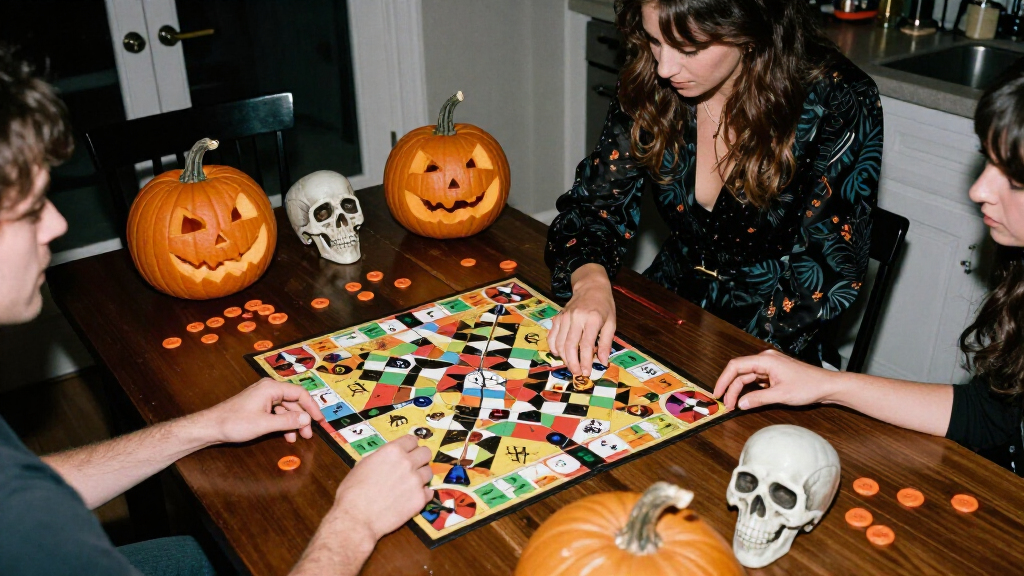
I compared these 14 games by the kind of Halloween night they support: social party play, cooperative problem-solving, strategy, deduction, trivia, or a themed mystery. I also weighed how readily a game appears suited to its intended audience, how much its horror theme shapes the play rather than the title alone, and whether its format can fit a casual gathering or asks for a more focused session. Group size and the likely commitment of the activity matter because a compact party game and a story-led mystery solve different hosting problems.
The order prioritizes broad usefulness for a Halloween game night, then distinguishes games with narrower strengths. Horrified: Universal Monsters ranks first for its blend of recognizable theme and cooperative strategy; party games follow for accessible group energy, while mystery and trivia picks serve more specific interests. I treat the listed titles as distinct experiences rather than assuming that every horror-branded game delivers the same level of tension, replay, or complexity. Each pick has a tradeoff: a focused theme may limit appeal, and a lighter rules load may come with less strategic depth.
Factors to Consider When Choosing Halloween Horror Board Games
Before choosing a title, decide what you want the group to do together. Halloween games range from fast social reactions to cooperative planning and clue-solving, and the right match depends on who is attending, how long you have, and how much attention the game demands.
Choose the kind of horror experience, not just the theme
A horror label can describe very different nights: slasher-style social tension, classic-monster strategy, haunted-house atmosphere, or a murder investigation. Ask whether your group wants to feel under pressure, solve a puzzle, trade jokes, or work together against a threat. A familiar film property can attract fans, but recognition alone does not guarantee that the play suits them. Check whether the horror is carried by the decisions players make or mainly by the setting and artwork. A common mistake is buying the scariest-sounding box for people who would rather chat than concentrate. For mixed groups, a recognizable theme paired with straightforward play is often a safer choice than a niche story experience.
Match the rules and session length to the gathering
A Halloween party often has interruptions, late arrivals, and players who have not read the rules. A game that needs sustained attention can be a poor fit even when everyone likes horror. Think about whether you can teach the rules before play, whether people can join or leave easily, and whether the group has time to finish. Short, social formats tend to tolerate a noisy room better than a mystery that depends on remembering clues. If the game is the main event, a more involved experience may be rewarding; if it is one activity among several, choose a format that can start quickly. Avoid judging suitability by box theme alone—complexity and pacing shape the evening just as much.
Check player count against the people who will actually attend
Use your expected attendance, not the maximum number of invitations, to guide the choice. A game designed for a smaller table can leave people waiting or excluded at a larger party, while a highly social game may feel thin with only two or three players. Consider whether the group enjoys taking turns, discussing options, or reacting all at once. Also think about whether everyone needs to be involved throughout or can comfortably watch between turns. For a recurring Halloween gathering, a flexible player range can be more useful than a game tuned to one exact group size. Check the published player information before buying, especially if your group often changes at the last minute.
Decide how much cooperation or competition your group enjoys
Cooperative games let players plan together, which can help newcomers feel included, but they may suit the group less if one person tends to direct every decision. Competitive party games can create lively table talk, yet their humor or pressure may not work for players who dislike confrontation. Deduction formats add a different tension: the pleasure comes from comparing evidence, not necessarily from acting out a horror scenario. Before choosing, consider whether your guests like shared goals, individual winners, bluffing, or quiet reasoning. A mixed group may appreciate a game with clear turns and an obvious shared objective. Do not assume cooperation automatically makes a game easier; players may still need to coordinate complicated choices.
Pay for depth only when your group will use it
A more involved game can offer richer decisions or a story to unpack, but those strengths matter only if your group has the time and interest to engage with them. A lighter game may provide better use for a one-night party, even if it offers less strategic depth. For repeat gatherings, consider whether the game can vary from session to session or whether its appeal relies on solving a mystery once. With story-led investigation games, think about whether your household wants a one-time experience or a title to replay with different groups. Components and presentation can add to the occasion, but they should support the activity rather than replace it. Spend extra attention on play style and repeat-use potential before treating a premium-feeling theme as a reason to choose.
Make the theme welcoming for the least horror-hardened guest
Horror enthusiasm varies widely, even among friends who all attend a Halloween party. Some guests enjoy movie references and spooky art but dislike intense themes, while others want a more unsettling or suspenseful session. Check the specific franchise or premise rather than relying on a general horror label to judge fit. Trivia and classic-monster themes can offer a different tone from slasher settings or murder investigations, though individual comfort levels still vary. When children or horror newcomers may join, choose for the most cautious regular player rather than the most enthusiastic fan. The goal is a game people will willingly play, not simply one with the strongest horror branding.
Frequently Asked Questions
Which game in this roundup is the best choice for a mixed-experience group?
Horrified: Universal Monsters is my strongest all-around recommendation for a group that wants a shared objective and a recognizable horror theme. Cooperative play gives newcomers a reason to discuss decisions with the table instead of competing alone. If your gathering is loud, casual, or likely to be interrupted, a party-oriented pick such as Don’t Get Stabbed! may fit better. The choice comes down to whether the group wants to plan together or prioritize quick social reactions. Match the game to the room’s energy, not just to players’ horror fandom.
Are the murder mystery games a good choice for a Halloween party?
They can be a strong fit when the game is the main activity and guests want to focus on clues and discussion. They are less suitable as background entertainment because interruptions can make it harder to follow an investigation. Consider whether your group enjoys reading, comparing evidence, and reaching a shared or individual conclusion. A party with frequent arrivals and departures may work better with a quick-start social game or trivia. Check the format and expected commitment before choosing a story-led mystery for a single evening.
What should I choose if some guests dislike scary games?
Start with the tone and premise rather than assuming all horror themes feel alike. Classic-monster settings, trivia, or deduction may be more comfortable for some guests than slasher-focused play or a grim murder mystery, though preferences differ. Ask guests about specific themes if you already know they have limits. A game with a lighter social format can keep the Halloween mood without requiring everyone to enjoy intense suspense. When in doubt, choose for the most cautious person who is expected to play.
Should I buy a cooperative game or a party game for a larger gathering?
For a lively group that wants easy conversation and quick reactions, a party game is usually the more natural starting point. A cooperative game is a better fit when attendees are willing to gather around the same table and make decisions together. Neither label guarantees that a game works at every group size, so check the listed player range and think about how the game handles people waiting for a turn. If guests will arrive at different times, prioritize a format that is easy to explain and enter. For a smaller, settled group, cooperative strategy can offer more shared focus than a party format.
Which titles are best if I want horror movie or monster themes specifically?
For classic creatures, Horrified: Universal Monsters and CLUE: Universal Monsters Edition take different routes: one centers on cooperative monster challenges, while the other uses a deduction framework. Players drawn to slasher-film branding can compare Halloween 1978, Halloween 2, and Scream: The Game. Chucky offers another familiar horror-property option, while the Hunt A Killer titles focus on investigation. Choose by the activity you want, since a licensed theme does not tell you whether the game is strategic, social, or mystery-led.
Conclusion
My best overall recommendation is Ravensburger Horrified: Universal Monsters for groups seeking cooperative horror strategy with a familiar cast. For best value in a casual game night, I would start with Don’t Get Stabbed! when quick party energy matters more than a long strategic session; for best premium-style experience, choose a Hunt A Killer mystery if your group wants a focused investigation rather than a replayable party game. Best for beginners goes to Horror Trivia Card Game with 300 Questions for groups who prefer a familiar question-and-answer format, while The Night Cage is my pick for players seeking a more atmospheric cooperative challenge. For movie fans, compare the Halloween and Scream titles by franchise preference; for classic-monster deduction, choose CLUE: Universal Monsters Edition. Start with your group’s preferred activity and tolerance for horror, then select the theme that fits.
NFL season / tailgating Picks
team gear
As an affiliate, we earn on qualifying purchases.