
TL;DR
Thorsten Meyer AI’s July 1 dispatch reframes Anthropic’s June 30 Claude Code guidance on agentic loops as a four-step delegation ladder. The confirmed development is a new interpretation of Anthropic’s loop types, showing what users stop doing as they move from manual prompting to proactive workflows.
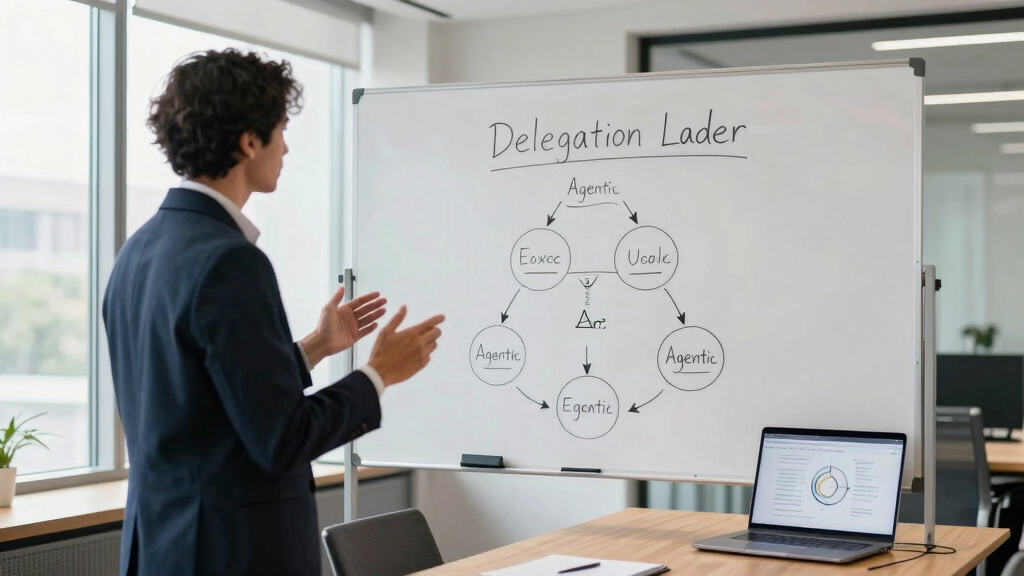
Thorsten Meyer AI published a July 1 analysis that recasts Anthropic’s new Claude Code guidance on agentic loops as a four-rung delegation ladder, arguing that the key question for users is not how to prompt harder but which part of the work they can safely stop doing themselves.
The dispatch is based on Anthropic’s June 30 Claude blog post, “Getting started with loops”, by Delba de Oliveira and Michael Segner. According to the dispatch, Anthropic defines a loop as an agent repeating cycles of work until a stop condition is met.
Thorsten Meyer AI’s framing groups the model into four loop types: turn-based skills, goal-based loops, time-based loops and proactive workflows. The dispatch says each rung hands off a different part of the process: checking, then deciding when to stop, then starting the work, and finally asking for the work in the first place.
The source material says Anthropic’s definitions, primitives and examples are Anthropic’s, while the “delegation ladder” interpretation is the author’s. It also says some features are research previews, meaning availability and behavior may still change.
The delegation ladder: four agentic loops, and what each lets you stop doing
Strip the hype and a “loop” is simple — an agent repeating work until a stop condition is met. The useful lens isn’t the mechanics, it’s what you hand off. Four loop types = four rungs of delegation, from a tool you operate to a process that runs.
The whole framework reduces to one question about your own work: where am I the bottleneck, and which single piece can I hand off? Can you write the check? Is the goal concrete? Does the work arrive on a schedule? That answer picks your rung — and you climb one step at a time. The real skill isn’t operating a loop; it’s the judgment of what to delegate and how far — enough hands off to gain leverage, enough on the wheel that “runs without you” doesn’t become “runs away from you.”
Delegation Becomes the Core Question
The dispatch matters because it translates a technical framework into a practical decision for teams using AI agents: where is the human the bottleneck, and which single piece of work can be handed off next?
For developers, the framework links agentic design to verification, cost controls and clear stopping rules. For business readers, it describes a shift from AI as a tool that waits for instructions to AI as a process that can run under defined limits.
The analysis also adds a caution: higher autonomy is not automatically better. The dispatch says teams should start with the simplest workable setup and climb only when the task justifies more delegation.
Building AI Agents for Network Operations: Design LLM-powered NetOps workflows with Python, Ollama, MCP, and tool calling
As an affiliate, we earn on qualifying purchases.
As an affiliate, we earn on qualifying purchases.
Anthropic’s Loop Types Reframed
The first rung, turn-based skills, keeps the user in control of each prompt while giving the agent stronger self-checking steps. The dispatch cites Anthropic’s example of a front-end skill that validates a UI change by running the app, clicking the control, checking screenshots, reviewing the console and measuring performance.
The second rung, goal-based loops, hands off the stop condition. In the example described by the dispatch, a user could set a measurable goal, such as raising a homepage performance score above 90, and cap the number of attempts.
The third rung, time-based loops, lets a schedule trigger the work. The fourth, proactive workflows, moves further toward event-driven work, where systems can coordinate agents without a human prompt in real time.
“A loop is an agent repeating cycles of work until a stop condition is met.”
— Anthropic, as summarized by Thorsten Meyer AI
![Express Schedule Free Employee Scheduling Software [PC/Mac Download]](https://m.media-amazon.com/images/I/41yvuCFIVfS._SL500_.jpg)
Express Schedule Free Employee Scheduling Software [PC/Mac Download]
- User-friendly drag & drop interface: Simple shift planning
- Manage time-off and holidays: Add sick leave, breaks, holidays
- Email schedules to employees: Send schedules directly via email
As an affiliate, we earn on qualifying purchases.
As an affiliate, we earn on qualifying purchases.
Limits And Availability Still Vary
It is not yet clear how broadly all of the cited loop primitives will be used in production workflows. The source material says some features are research previews, so teams may face changing interfaces, limits or behavior.
The impact will also depend on how clearly users can define success criteria. The dispatch says deterministic checks, such as passing tests or crossing a score threshold, fit agent loops better than vague goals.
Robotic Process Automation: Guide To Building Software Robots, Automate Repetitive Tasks & Become An RPA Consultant
As an affiliate, we earn on qualifying purchases.
As an affiliate, we earn on qualifying purchases.
Pilots Before Large Agent Runs
The dispatch points to a measured rollout path: use the right primitive, pick the cheapest capable model, define stop criteria and pilot before large runs involving many agents.
Teams adopting the framework will likely test the lower rungs first, especially skills with self-verification and goal loops with caps, before relying on scheduled or event-driven workflows.

1000+ AI Prompts to Master Every AI Tool: The Ultimate Playbook for ChatGPT, Gemini, Claude, Midjourney, Perplexity, Notion AI, and More
As an affiliate, we earn on qualifying purchases.
As an affiliate, we earn on qualifying purchases.
Key Questions
What is the actual news here?
The news is that Thorsten Meyer AI published a July 1 analysis reframing Anthropic’s June 30 Claude Code loop guidance as a four-step delegation ladder.
What are the four agentic loops?
The dispatch identifies turn-based skills, goal-based loops, time-based loops and proactive workflows as four levels of delegation.
What is confirmed and what is interpretation?
The loop definitions and examples are attributed to Anthropic. The delegation ladder framing is Thorsten Meyer AI’s interpretation of that guidance.
Why should teams care?
The framework gives teams a practical way to decide how much work to hand off to AI agents while keeping limits around quality, cost and completion criteria.
Are these tools ready for every workflow?
No. The source material says some features are research previews, and the dispatch says teams should start with the simplest useful loop before moving toward more autonomous setups.
Source: Thorsten Meyer AI