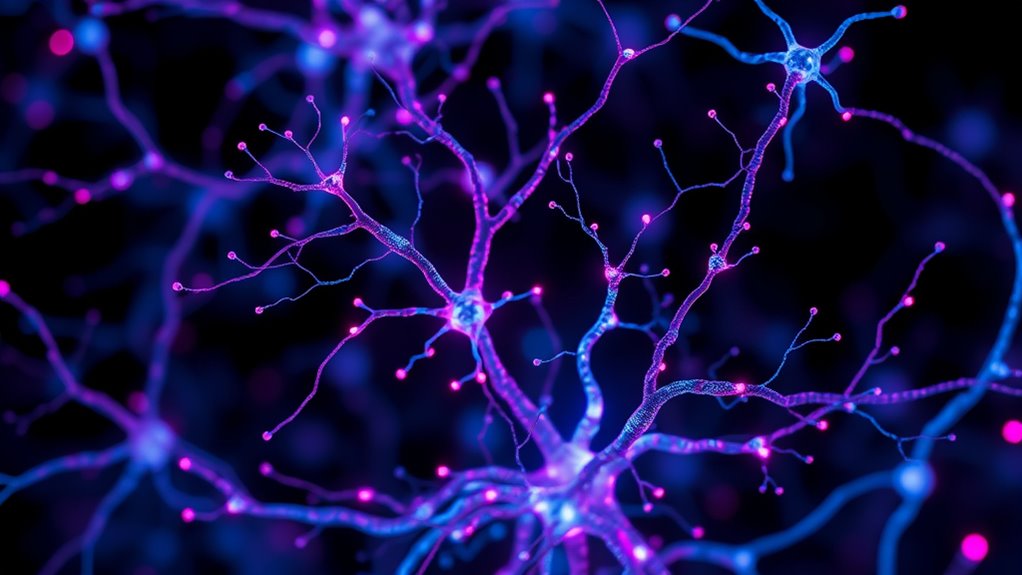

When you repeat routines, your brain builds specific neural pathways that make those actions automatic over time. Dopamine reinforces these behaviors by giving you pleasurable feelings, encouraging you to repeat them. As these pathways strengthen, behaviors become more efficient and require less mental effort. This process rewires your brain, turning conscious actions into habits. Keep exploring, and you’ll discover how the science behind these neural changes can help you create lasting routines.

Get the little things that make your day delivered free with Prime
- Fast, free delivery on millions of items
- Prime Video, Amazon Music and more included
- Member-only deals all year
Key Takeaways
- Repetition creates neural circuits that reinforce behaviors, making routines easier over time.
- Dopamine release during rewarding actions strengthens habits by linking cues with positive feelings.
- Repeated behaviors lead to more efficient neural pathways, enabling habits to operate automatically.
- Brain rewiring through consistent practice transforms new routines into effortless, ingrained actions.
- Strategies that trigger dopamine rewards enhance habit formation and neural pathway strengthening.

Have you ever wondered how some habits seem to form effortlessly while others take forever? The secret lies in how your brain rewires itself through neural pathways. When you repeat an action, your brain creates a specific circuit that makes that behavior easier over time. Think of neural pathways as trails in a forest: the more you walk down a particular path, the clearer and more established it becomes. Initially, forming a new habit feels challenging because your brain is unaccustomed to the behavior. But with consistent repetition, these pathways strengthen, making the action feel more natural and automatic.
Dopamine triggers play an indispensable role in this process. Every time you engage in a behavior that rewards you, your brain releases dopamine, a neurotransmitter associated with pleasure and motivation. This surge of dopamine acts as a positive reinforcement, encouraging you to repeat the activity. For example, when you finish a workout or complete a task successfully, that rush of good feelings makes you more likely to stick with the routine. Over time, your brain begins to associate certain cues with these dopamine hits, reinforcing the habit loop. This creates a cycle where the presence of a cue prompts the behavior, which then results in a dopamine release, further cementing the habit.
As you continue to repeat these behaviors, the neural pathways involved become more efficient. The brain starts to anticipate the reward even before the action is completed, making the habit feel almost automatic. This is why habits become ingrained so quickly once they’re established—your brain has fundamentally optimized the pathway for that specific behavior. The more you engage with the habit, the less cognitive effort it requires, freeing up mental resources for other tasks. This efficiency is what makes habits so powerful; they operate on autopilot, allowing you to conserve energy and mental bandwidth.
Understanding this process helps you realize that habits are not just about willpower but about how your brain adapts and rewires itself. By consistently engaging in the desired behavior, you strengthen neural pathways and tap into dopamine triggers that reinforce the routine. Incorporating strategies like exfoliation with glycolic acid can help in skin-related habits by promoting cell turnover and refining skin texture over time. Over time, what once felt like a struggle becomes second nature, almost effortless. That’s the science behind how routines get wired into your brain, making habits a fundamental part of your daily life.
As an affiliate, we earn on qualifying purchases.
Frequently Asked Questions
Can Habits Be Completely Changed or Only Modified?
You can absolutely change your habits, not just modify them. Through deliberate habit disruption, you break the old routine’s wiring and create new pathways. Consistently reinforcing the desired behavior helps solidify these changes, making new habits more automatic over time. While complete transformation takes effort and patience, persistence in routine reinforcement allows you to replace old habits entirely with healthier or more productive ones.
How Long Does It Typically Take to Form a New Habit?
You’ll probably need about 21 to 66 days to form a new habit, but don’t hold your breath for perfection. Habit strength builds as you maintain routine consistency, turning fleeting actions into automatic responses. Expect some days to feel easier, others to test your patience. Keep at it, and in a few weeks, your new routine will feel as natural as breathing—minus the awkwardness of starting.
Do Genetics Influence Habit Formation or Susceptibility?
Genetics do influence your habit formation and susceptibility by shaping neurological factors like brain plasticity and impulse control. Your genetic predispositions can make it easier or harder to develop certain habits, as they affect how your brain responds to routines and rewards. While you can still form new habits through consistent effort, understanding your genetic makeup helps you tailor strategies that align with your neurological strengths and weaknesses.
What Role Do Emotions Play in Establishing Routines?
You might notice that emotions often unexpectedly influence your routines. Emotional reinforcement strengthens habits, making you more likely to repeat behaviors that boost your mood. Conversely, routines can serve as mood regulation tools, helping you manage stress or anxiety. When you associate certain activities with positive feelings, they become ingrained habits, creating a cycle where emotions and routines reinforce each other, shaping your daily patterns without you even realizing it.
Can Habits Be Formed Consciously Without Awareness?
Yes, you can form habits consciously without full awareness, but subconscious influence often guides your actions. When you intentionally repeat behaviors, they can become automatic over time, even if you’re not actively thinking about them. Your brain wires routines through conscious awareness initially, but eventually, these habits operate below the surface of your conscious mind, making them feel natural and effortless.
neural pathway reinforcement tools
As an affiliate, we earn on qualifying purchases.
As an affiliate, we earn on qualifying purchases.
Conclusion
Understanding how habits form reveals that your brain prefers routines over effort. Just as a well-worn trail becomes easier to follow, your neural pathways strengthen with repetition, making habits automatic. But unlike a fragile path, these habits can be reshaped if you consciously redirect your actions. So, while routines seem effortless, they’re powerful—either holding you back or propelling you forward. The choice is yours: stay on the familiar trail or forge a new one.
As an affiliate, we earn on qualifying purchases.
As an affiliate, we earn on qualifying purchases.
NFL season / tailgating Picks
team gear
As an affiliate, we earn on qualifying purchases.